What Buyers Need to Know
If you have been searching for homes in Portland and come across listings that do not fit neatly into the categories you expected, you are not imagining things. Portland's housing landscape has been changing, and the range of what buyers can purchase, and what sellers can build and sell, is broader than it was five years ago. Understanding middle housing helps make sense of what you are seeing.

Why Middle Housing Exists
Portland sits inside Oregon's urban growth boundary, a line that limits how far the metro area can expand outward. We wrote about that in more detail in our [urban growth boundary explainer], but the short version is this: when you cannot build out, you have to build in. Middle housing is one of Oregon's primary answers to that constraint.
In 2019 Oregon passed House Bill 2001, which effectively ended single-family only zoning across most of the state. In Portland and other large cities, that meant property owners and developers could now build a broader range of housing types on lots that previously could only hold one house. The goal was to increase housing supply inside existing neighborhoods without changing their fundamental character.
The results are still working their way through the market, but buyers are starting to see more variety in what is available, and that variety comes with real advantages depending on what you are looking for.
What Middle Housing Actually Means
Middle housing refers to residential building types that fall between a single-family home and a large apartment complex. They are designed to fit into existing residential neighborhoods at a scale that does not dramatically alter the streetscape. In Portland, the middle housing types now permitted include:
Duplexes, which place two units on one lot, either side by side or stacked. They can be owned as a single property with one unit rented out, or in some cases converted into separately owned condominiums.
Triplexes and fourplexes, which follow the same logic at slightly larger scale. These are increasingly common in Portland's inner neighborhoods where lot sizes and existing infrastructure can support them.
Townhouses, which are attached units that share one or more walls but typically have their own entrances and often their own small outdoor spaces. They usually sit on their own individual lots.
Cottage clusters, which are collections of smaller detached homes arranged around a shared courtyard or common outdoor area. Each cottage sits on its own surveyed lot with its own legal title, and the walls do not touch. This is an important distinction for buyers because it means you are purchasing fee simple ownership of your unit and its lot, not a share of a larger parcel.
Accessory dwelling units, or ADUs, which are secondary units added to a property that already has a primary home. These can be detached structures in the backyard, converted garages, or internal units carved out of an existing house. View Portland homes with ADUs here.
What This Looks Like in Practice
We recently worked with a buyer who knew exactly what she wanted and what she did not want. She wanted her own front door, her own outdoor space, and no shared walls. She did not want a large yard or significant maintenance responsibilities. A traditional single-family home on a standard Portland lot would have given her more yard than she wanted to manage. A condo would have meant shared walls and HOA dynamics she was not interested in.
What she found was made possible by exactly the kind of development middle housing policy is designed to encourage. A longtime owner of a standard Portland lot had maintained the original single-family home on one portion of the property, then split the remaining half into three individual lots and built three new small homes on them. Each was surveyed and platted as its own legal parcel with its own title. The walls did not touch. Each home had its own private outdoor space and parking right in front.
Her unit was 1,500 square feet of lot, which sounds modest until you consider what it did not come with. No shared walls, no lawn to mow on a Saturday, no HOA board to navigate, and no maintenance responsibilities beyond her own small space. She owned her home and her lot outright, the same as any single-family buyer, just at a scale that actually fit her life.
Because cottage clusters are still relatively new and less understood by the general buying public, the price point was more accessible than comparable single-family options nearby. That gap will close as more buyers become familiar with the type. For now it remains a real opportunity for buyers who know what they are looking for.
That kind of fit is what middle housing makes possible. It opens up options for buyers whose needs do not map neatly onto a traditional single-family home or a conventional condo.
Walkable Neighborhoods and Middle Housing
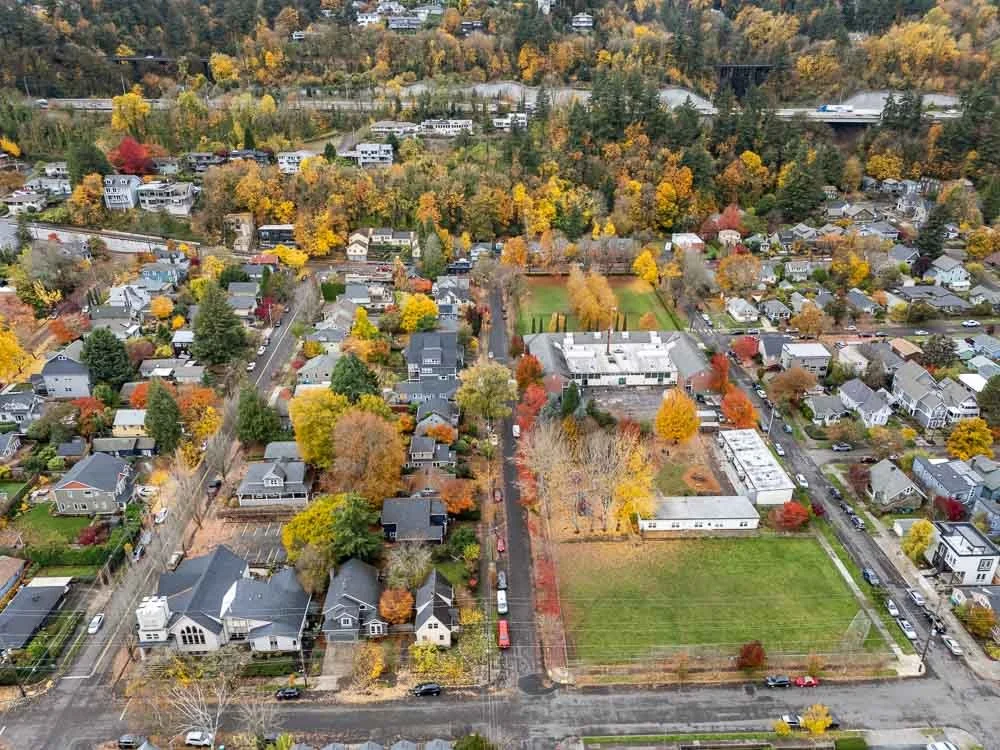
One of the reasons middle housing tends to work well in Portland is that it is concentrated in the neighborhoods where walkability already exists. Duplexes, cottage clusters, and townhouses are most common in inner Southeast, Northeast, and North Portland, where the street grid, transit access, and commercial corridors already support a higher density of residents.
For buyers who prioritize being able to walk to coffee, transit, restaurants, and daily errands, middle housing in these neighborhoods often delivers exactly that. The trade-off is typically less private outdoor space and closer proximity to neighbors. For the right buyer, that is not a trade-off at all.

What to Know Before You Buy
Middle housing comes with some considerations that are worth understanding before you make an offer.
HOA structures vary significantly. Cottage clusters and some townhouse developments have homeowners associations that govern shared spaces and exterior maintenance. The quality of those associations, their financial reserves, and their governing documents matter and should be reviewed carefully before closing.
Financing can be more complicated for newer middle housing types. Some lenders are still catching up to the legal structures that Oregon's middle housing laws created. Cottage cluster units on individual lots generally finance like single-family homes, but it is worth confirming with your lender early in the process.
Resale liquidity is still developing for some of these types. Cottage clusters in particular are new enough that there is limited comparable sales data in some neighborhoods. That can make appraisals more complicated and pricing less straightforward than it is for conventional housing types.
None of these are reasons to avoid middle housing. They are reasons to work with an agent who understands what they are looking at and can help you ask the right questions before you commit.
The Bigger Picture
Middle housing is not a trend. It is a structural response to the land use constraints that define how Portland grows. As more of these properties come to market and more buyers become familiar with the options, middle housing will increasingly be part of mainstream Portland real estate rather than a niche category.
For buyers who are open to it, that represents real opportunity, both in terms of finding a home that fits an unconventional set of needs and in terms of price points that have not yet fully caught up to the value on offer.
This article is for educational purposes only and is not legal, financial, or tax advice. Every situation is different. We recommend consulting with a qualified attorney or land use professional for questions specific to your circumstances.
Looking for the Right Portland Neighborhood?
Portland neighborhoods vary more than most people expect. Our guide to the best Portland neighborhoods covers the city's main areas by location, character, and what it is actually like to live there. Or try our Portland Neighborhood quiz to see what neighborhoods might fit your lifestyle.


Thinking About Buying in Portland?
Whether you are looking at a cottage cluster, a classic bungalow, or something in between, we are happy to talk through what the options look like for your situation. The Portland market has more variety than most buyers realize when they start their search.
Kim Campbell, Realtor | PSA, RENE | Licensed Oregon Broker
Francisco Salgado, Realtor | MCNE, EA | Licensed Oregon and Washington Broker
Campbell Salgado Real Estate Group with Soldera Properties